qualitest2016 No Comments

Anchor Pull-Out Testing services in Vancouver BC

Anchor Pull-Out Testing services in Vancouver BC

Qualitest Canada provides specialized Anchor Pull-Out Testing services in Vancouver BC and across Canada with its highly experienced technicians and advanced load testing equipment. Our coverage area extends to almost every major city and town in Canada including Mississauga, Hamilton, Sarnia, Milton, St. Catharines, Ottawa, Brampton, Sudbury, London, Markham, Vaughan, Kitchener, Windsor, Vancouver, Surrey, Langley, Richmond, Delta, Burnaby, Victoria, Kitimat, Dawson Creek, Kelowna, Kamloops, Edmonton, Calgary, Red Deer, Peace River, Grande Prairie, Fort McMurray, Regina, and Saskatoon.

Understanding Pull-Out Testing

Pull-Out Testing is a non-destructive or controlled destructive test used to determine the load capacity and strength of installed anchors, bolts, rebars, screws, fasteners, and other fixings in concrete, masonry, or structural elements. It provides valuable data on whether these embedded elements can withstand the required loads specified in design and safety standards.

By performing pull-out testing, project teams can verify installation quality, validate design assumptions, and ensure the safety and durability of critical infrastructure.

Why Choose Qualitest Canada?

Qualitest Canada is a recognized leader in construction material testing and inspection services nationwide. With years of experience and a strong reputation for reliability, we deliver precise pull-out testing results that help clients make informed decisions. Our team uses calibrated equipment and follows industry standards to ensure accuracy and compliance.

Our Pull-Out Testing Services

  • Anchors & Bolts – load capacity verification for mechanical and adhesive anchors
  • Rebars – bond strength and pull-out resistance in reinforced concrete
  • Screws & Fasteners – testing for structural wood, steel, and concrete applications
  • Masonry Fixings – assessment of load resistance in brick or block walls
  • On-site Testing – portable test rigs allow accurate testing directly on project sites
  • Compliance Testing – performed to ASTM, ACI, CSA, and other international standards

Benefits of Pull-Out Testing

  • Confirms load-bearing capacity of fixings
  • Reduces risk of structural failure
  • Validates design and installation quality
  • Supports compliance with building codes and safety standards
  • Provides assurance for critical infrastructure and construction projects

Industries We Serve

  • Construction and Infrastructure
  • Commercial and Residential Buildings
  • Industrial Facilities
  • Oil & Gas and Energy Projects
  • Transportation and Civil Works

Other Services by Qualitest Canada

In addition to Pull-Out Testing of Anchors, Bolts, Rebars, and Screws in Vancouver, Qualitest Canada also provides:

  • Concrete, Asphalt, Soil & Aggregate Testing
  • Steel & Welding Testing
  • Durometer ‘A’ Shore and ‘D’ Shore Hardness Testing
  • HDPE Burst Testing
  • Geotechnical Investigation
  • Environmental Site Assessments (ESA Phase I, II & III)
  • Utility Locating & GPR Services
  • Non-destructive Testing (NDT)

Contact Us

Email: admin@qualitests.com

  • Ontario Office: 5, 760 Laurentian Dr, Burlington, ON L7N 3V6, Canada | (647) 464-9480
  • Alberta Office: 702 – 23rd Ave, Nisku, AB T9E 7Y6, Canada | (780) 851-2020
  • Alberta Office: 320A – 65 Ave SE, Calgary, AB T2H 0R8, Canada | (587) 747-3787
  • British Columbia Office: 112, 13085 115 Ave, Surrey, BC V3R 0C3, Canada | (778) 381-7376


qualitest2016 No Comments

Durometer Hardness Testing Services in Vancouver BC

Durometer Hardness Testing services in Vancouver BC

Qualitest Canada provides specialized Durometer Hardness Testing services in Vancouver BC and across Canada with its highly skilled technicians and advanced testing equipment. Our service coverage extends to almost every major city and town in Canada including Mississauga, Hamilton, Sarnia, Milton, St. Catharines, Ottawa, Brampton, Sudbury, London, Markham, Vaughan, Kitchener, Windsor, Vancouver, Surrey, Langley, Richmond, Delta, Burnaby, Victoria, Kitimat, Dawson Creek, Kelowna, Kamloops, Edmonton, Calgary, Red Deer, Peace River, Grande Prairie, Fort McMurray, Regina, and Saskatoon.

Understanding Durometer Hardness Testing

Durometer hardness testing is a critical method used to measure the hardness of polymers, elastomers, and plastics. The test evaluates how resistant a material is to indentation under a specific load. Shore ‘A’ is typically used for softer materials such as rubber, elastomers, and flexible plastics, while Shore ‘D’ is suited for harder plastics and rigid materials.

By accurately determining hardness, manufacturers and contractors can ensure materials meet design specifications, maintain durability, and comply with quality control standards.

Why Choose Qualitest Canada?

Qualitest Canada is a trusted provider of non-destructive testing and material evaluation services across the country. With years of expertise, we deliver precise and reliable hardness testing that supports industries such as manufacturing, construction, automotive, aerospace, and energy. Our commitment to accuracy and compliance ensures clients receive dependable results for their quality assurance needs.

Our Durometer Hardness Testing Services

  • Shore ‘A’ Hardness Testing – for rubber, elastomers, soft plastics, and flexible materials
  • Shore ‘D’ Hardness Testing – for rigid plastics, hard rubbers, and polymer-based materials
  • On-site and Laboratory Testing – portable durometers allow for field testing as well as controlled laboratory evaluation
  • Quality Control & Compliance – testing performed according to ASTM and ISO standards

Benefits of Durometer Testing

  • Ensures materials meet project specifications
  • Validates quality in manufacturing processes
  • Reduces risk of material failure in service
  • Provides data for R&D and product development
  • Supports compliance with industry standards

Industries We Serve

  • Manufacturing and Fabrication
  • Plastics and Polymer Industry
  • Construction and Infrastructure
  • Oil & Gas and Energy
  • Automotive and Aerospace

Other Services by Qualitest Canada

  • In addition to Durometer ‘A’ Shore and ‘D’ Shore Hardness Testing Services in Vancouver, Qualitest Canada also offers:
  • Concrete, Asphalt, Soil & Aggregate Testing
  • Steel & Welding Testing
  • HDPE Burst Testing
  • Geotechnical Investigation
  • Environmental Site Assessments (ESA Phase I, II & III)
  • Utility Locating & GPR Services
  • Non-destructive Testing (NDT)

Contact Us

Email: admin@qualitests.com

  • Ontario Office: 5, 760 Laurentian Dr, Burlington, ON L7N 3V6, Canada | (647) 464-9480
  • Alberta Office: 702 – 23rd Ave, Nisku, AB T9E 7Y6, Canada | (780) 851-2020
  • Alberta Office: 320A – 65 Ave SE, Calgary, AB T2H 0R8, Canada | (587) 747-3787
  • British Columbia Office: 112, 13085 115 Ave, Surrey, BC V3R 0C3, Canada | (778) 381-7376


qualitest2016 No Comments

Materials Testing Services in Vancouver BC

Materials Testing Services in Vancouver BC

Qualitest Canada provides comprehensive materials testing services in Vancouver BC and across Canada with its highly experienced field and laboratory technicians. Qualitest’s service area covers almost every major city and town in Canada including Mississauga, Hamilton, Sarnia, Milton, St. Catharines, Ottawa, Brampton, Sudbury, London, Markham, Vaughan, Kitchener, Windsor, Vancouver, Surrey, Langley, Richmond, Delta, Burnaby, Victoria, Kitimat, Dawson Creek, Kelowna, Kamloops, Edmonton, Calgary, Red Deer, Peace River, Grande Prairie, Fort McMurray, Regina, and Saskatoon.

Understanding the Importance of Materials Testing

Materials testing plays a vital role in construction, infrastructure, and manufacturing projects. It ensures the safety, quality, and durability of materials such as steels, other metallic components, concrete, asphalt, aggregates, soil, and welds. By conducting accurate laboratory and field tests, contractors and developers can avoid costly failures, improve project efficiency, and meet compliance with regulatory standards.

Why Choose Qualitest Canada?

Qualitest Canada emerges as a leading provider of construction materials testing and inspection solutions across the country. With a reputation for reliability and accuracy, Qualitest Canada has been serving clients in various industries for years. Our expertise in material testing makes us a trusted partner for construction companies, municipalities, developers, and infrastructure projects.

Our Materials Testing Services

  • Concrete Testing – compressive strength, slump, air content, density, maturity testing
  • Soil Testing – compaction, moisture-density relationship (Proctor), permeability, classification
  • Aggregate Testing – gradation, abrasion resistance, specific gravity, absorption
  • Asphalt Testing – Marshall stability, density, compaction, extraction testing
  • Steel & Welding Testing – tensile strength, bend testing, hardness, impact, and NDT verification
  • Laboratory & Field Testing Services – on-site and accredited laboratory analysis

Commitment to Accuracy, Efficiency & Compliance

Qualitest Canada employs state-of-the-art testing equipment and experienced technicians to ensure precise results. By adhering to industry standards and regulations, we guarantee compliance with safety and environmental requirements. While some may perceive material testing services as an additional expense, the cost of not investing in them can far outweigh the initial outlay. Preventing failures, delays, and safety incidents ultimately saves money in the long run.

Industries We Serve

  • Construction and Infrastructure
  • Municipalities and Utilities
  • Transportation and Highways
  • Oil & Gas and Mining
  • Manufacturing and Fabrication

Proven Track Record

Qualitest Canada has a proven track record of success in material testing, demonstrated through numerous case studies and client success stories. By showcasing real-world examples of our work, potential clients gain confidence in the benefits of partnering with us for their projects.

Other Services by Qualitest Canada

In addition to Materials Testing Services in Vancouver, Qualitest Canada provides:

  • Rail Slow Bend Testing as per AREMA requirements
  • HDPE Burst Testing
  • Welding Engineering
  • Geotechnical Investigation
  • Environmental Site Assessments (ESA Phase I, II & III)
  • Non-destructive Testing (NDT)
  • Utility Locating & GPR Services


Contact Us

Email: admin@qualitests.com

  • Ontario Office: 5, 760 Laurentian Dr, Burlington, ON L7N 3V6, Canada | (647) 464-9480
  • Alberta Office: 702 – 23rd Ave, Nisku, AB T9E 7Y6, Canada | (780) 851-2020
  • Alberta Office: 320A – 65 Ave SE, Calgary, AB T2H 0R8, Canada | (587) 747-3787
  • British Columbia Office: 112, 13085 115 Ave, Surrey, BC V3R 0C3, Canada | (778) 381-7376
qualitest2016 No Comments

Material Testing Services in Vancouver BC

Material Testing Services in Vancouver BC

Qualitest Canada provides comprehensive material testing services in Vancouver BC and across Canada with its highly experienced field and laboratory technicians. Qualitest’s service area covers almost every major city and town in Canada including Mississauga, Hamilton, Sarnia, Milton, St. Catharines, Ottawa, Brampton, Sudbury, London, Markham, Vaughan, Kitchener, Windsor, Vancouver, Surrey, Langley, Richmond, Delta, Burnaby, Victoria, Kitimat, Dawson Creek, Kelowna, Kamloops, Edmonton, Calgary, Red Deer, Peace River, Grande Prairie, Fort McMurray, Regina, and Saskatoon.

Understanding the Importance of Material Testing

Material testing plays a vital role in construction, infrastructure, and manufacturing projects. It ensures the safety, quality, and durability of materials such as steels, other metallic components, concrete, asphalt, aggregates, soil, and welds. By conducting accurate laboratory and field tests, contractors and developers can avoid costly failures, improve project efficiency, and meet compliance with regulatory standards.

Why Choose Qualitest Canada?

Qualitest Canada emerges as a leading provider of construction materials testing and inspection solutions across the country. With a reputation for reliability and accuracy, Qualitest Canada has been serving clients in various industries for years. Our expertise in material testing makes us a trusted partner for construction companies, municipalities, developers, and infrastructure projects.

Our Material Testing Services

  • Concrete Testing – compressive strength, slump, air content, density, maturity testing
  • Soil Testing – compaction, moisture-density relationship (Proctor), permeability, classification
  • Aggregate Testing – gradation, abrasion resistance, specific gravity, absorption
  • Asphalt Testing – Marshall stability, density, compaction, extraction testing
  • Steel & Welding Testing – tensile strength, bend testing, hardness, impact, and NDT verification
  • Laboratory & Field Testing Services – on-site and accredited laboratory analysis

Commitment to Accuracy, Efficiency & Compliance

Qualitest Canada employs state-of-the-art testing equipment and experienced technicians to ensure precise results. By adhering to industry standards and regulations, we guarantee compliance with safety and environmental requirements. While some may perceive material testing services as an additional expense, the cost of not investing in them can far outweigh the initial outlay. Preventing failures, delays, and safety incidents ultimately saves money in the long run.

Industries We Serve

  • Construction and Infrastructure
  • Municipalities and Utilities
  • Transportation and Highways
  • Oil & Gas and Mining
  • Manufacturing and Fabrication

Proven Track Record

Qualitest Canada has a proven track record of success in material testing, demonstrated through numerous case studies and client success stories. By showcasing real-world examples of our work, potential clients gain confidence in the benefits of partnering with us for their projects.

Other Services by Qualitest Canada

In addition to Material Testing Services in Vancouver, Qualitest Canada provides:

  • Rail Slow Bend Testing as per AREMA requirements
  • HDPE Burst Testing
  • Welding Engineering
  • Geotechnical Investigation
  • Environmental Site Assessments (ESA Phase I, II & III)
  • Non-destructive Testing (NDT)
  • Utility Locating & GPR Services

HDPE Pipeline Hydro Testing


Hydro Test

Contact Us

Email: admin@qualitests.com

  • Ontario Office: 5, 760 Laurentian Dr, Burlington, ON L7N 3V6, Canada | (647) 464-9480
  • Alberta Office: 702 – 23rd Ave, Nisku, AB T9E 7Y6, Canada | (780) 851-2020
  • Alberta Office: 320A – 65 Ave SE, Calgary, AB T2H 0R8, Canada | (587) 747-3787
  • British Columbia Office: 112, 13085 115 Ave, Surrey, BC V3R 0C3, Canada | (778) 381-7376


qualitest2016 No Comments

Slow-Bend Test of Rail Welds in accordance with AREMA and AWS standards 

Slow-Bend Test of Rail Welds in accordance with AREMA and AWS standards 

Qualitest Canada. performs 4-point Slow-Bend Test of Rail Welds in accordance with AREMA and AWS standards throughout Canada with its highly experienced engineers and technicians. Our service area covers almost every major city and town in Canada, including Mississauga, Hamilton, Sarnia, Milton, St. Catharines, Ottawa, Brampton, Sudbury, London, Markham, Vaughan, Kitchener, Windsor, Vancouver, Surrey, Langley, Richmond, Delta, Burnaby, Victoria, Kitimat, Dawson Creek, Kelowna, Kamloops, Edmonton, Calgary, Red Deer, Peace River, Grande Prairie, Fort McMurray, Regina, and Saskatoon.

Introduction to Rail Weld Testing

At Qualitest Canada Ltd., we understand the critical importance of rail weld testing for ensuring the safety and durability of railway tracks. The AREMA (American Railway Engineering and Maintenance-of-Way Association) and AWS (American Welding Society) standards provide essential guidelines for the slow-bend test, which is crucial for evaluating the strength of rail welds. This test helps identify any weaknesses that could lead to track failures, ensuring that rails are safe for use.

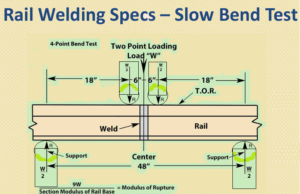
AREMA 4 Point Bend Test

             Slow-Bend Test of Rail Welds

Importance of Slow-Bend Test

The slow-bend test is a vital procedure in maintaining railway safety. It replicates real-world conditions to test the weld’s integrity under stress. By applying a controlled force, the test identifies potential weak points, ensuring that the rail can endure daily operational stresses.

Setting Up the 4-Point Test

Setting up the 4-point test requires precision and strict adherence to standards. Here is a step-by-step guide to ensure accurate results:

Prepare the Rail Sample

Cut the rail sample to the specified length: Ensure the rail sample meets the required dimensions according to AREMA and AWS guidelines.

Ensure the sample is free from defects and impurities: Inspect the sample to remove any surface contaminants or imperfections that could affect the test results.

Align the Test Equipment

Position the rail sample in the testing machine: Secure the sample firmly in place to prevent movement during the test.

Align the supports and loading points according to AREMA and AWS specifications: Proper alignment is crucial for the accuracy of the test. The supports should be positioned symmetrically at the specified distance apart, and the loading points should be equidistant from the supports.

Apply the Load

Gradually apply the load to the rail sample: Increase the load slowly and steadily to avoid sudden impacts that could skew the results.

Monitor the force and deformation closely: Use precise instrumentation to measure the force applied and the resulting deformation of the rail sample.

Record the Results

Document the load and displacement at failure: Record the maximum load the sample withstands and the corresponding displacement at the point of failure.

Analyze the data to determine the weld’s strength: Evaluate the results to assess the weld’s performance and identify any potential issues.

Benefits of Adhering to Standards

Adhering to AREMA and AWS standards ensures consistency and reliability in testing. These standards provide a uniform method for evaluating rail welds, making it easier to compare results across different samples and conditions. This uniformity is crucial for maintaining safety across the railway network.

Common Issues and Solutions

During the slow-bend test, several issues may arise. Here are some common problems and their solutions:

Misalignment of Sample: Ensure the sample is correctly positioned and aligned before applying the load. Double-check the alignment to avoid inaccurate results.

Inaccurate Load Application: Regularly calibrate the testing machine to maintain accuracy. Use properly maintained equipment to ensure the load is applied consistently.

Data Recording Errors: Use reliable data acquisition systems to capture precise measurements. Verify the data recording process to avoid errors in the results.

Conclusion

At Qualitest Canada., we are dedicated to ensuring the highest standards in rail weld testing. The 4-point set-up for the AREMA and AWS slow-bend test is essential for evaluating rail welds. By following these guidelines and maintaining precision, we help railway companies ensure the safety and durability of their tracks. Regular testing and adherence to standards are key to preventing track failures and ensuring smooth operations.

Other Services by Qualitest Canada

Qualitest Canada also provides world-class engineering services in Canada, focusing on:

  • Concrete Scanning with Ultrasonic Pulsed Echo
  • Utility Locating
  • HDPE Burst Test
  • Welding Engineering
  • Geotechnical Investigation
  • Environmental Site Assessment (ESA Phase I, II, and III)
  • Construction Materials Testing Services
  • Non-destructive Testing for Steel, Polymers, and Concrete Structures
  • For more information about our services, please contact Qualitest Canada.

For more information or a quote, email us at admin@qualitests.com today.

qualitest2016 No Comments

AREMA and AWS Slow-Bend Test of Rail Welds

Standard 4-Point Set-Up for AREMA and AWS Slow-Bend Test of Rail Welds

Qualitest Canada performs 4-point AREMA and AWS Slow-Bend Test of Rail Welds throughout Canada with its highly experienced engineers and technicians. Our service area covers almost every major city and town in Canada, including Mississauga, Hamilton, Sarnia, Milton, St. Catharines, Ottawa, Brampton, Sudbury, London, Markham, Vaughan, Kitchener, Windsor, Vancouver, Surrey, Langley, Richmond, Delta, Burnaby, Victoria, Kitimat, Dawson Creek, Kelowna, Kamloops, Edmonton, Calgary, Red Deer, Peace River, Grande Prairie, Fort McMurray, Regina, and Saskatoon.

AREMA and AWS slow-bend tests of rail welds

At Qualitest Canada, we recognize the critical importance of rail weld testing for ensuring the safety and durability of railway tracks. The AREMA (American Railway Engineering and Maintenance-of-Way Association) and AWS (American Welding Society) standards provide essential guidelines for the slow-bend test, which is crucial for evaluating the strength of rail welds. This test helps identify any weaknesses that could lead to track failures, ensuring that rails are safe for use.

AREMA and AWS Slow-Bend Test of Rail Welds

AREMA and AWS Slow-Bend Test of Rail Welds

Importance of Slow-Bend Test

The slow-bend test is a vital procedure in maintaining railway safety. It replicates real-world conditions to test the weld’s integrity under stress. By applying a controlled force, the test identifies potential weak points, ensuring that the rail can endure daily operational stresses.

Setting Up the 4-Point Test

Setting up the 4-point test requires precision and strict adherence to standards. Here is a step-by-step guide to ensure accurate results:

Prepare the Rail Sample

  • Cut the rail sample to the specified length: Ensure the rail sample meets the required dimensions according to AREMA and AWS guidelines.
  • Ensure the sample is free from defects and impurities: Inspect the sample to remove any surface contaminants or imperfections that could affect the test results.

Align the Test Equipment

  • Position the rail sample in the testing machine: Secure the sample firmly in place to prevent movement during the test.
  • Align the supports and loading points according to AREMA and AWS specifications: Proper alignment is crucial for the accuracy of the test. The supports should be positioned symmetrically at the specified distance apart, and the loading points should be equidistant from the supports.

Apply the Load

  • Gradually apply the load to the rail sample: Increase the load slowly and steadily to avoid sudden impacts that could skew the results.
  • Monitor the force and deformation closely: Use precise instrumentation to measure the force applied and the resulting deformation of the rail sample.

Record the Results

  • Document the load and displacement at failure: Record the maximum load the sample withstands and the corresponding displacement at the point of failure.
  • Analyze the data to determine the weld’s strength: Evaluate the results to assess the weld’s performance and identify any potential issues.

Benefits of Adhering to Standards

Adhering to AREMA and AWS standards ensures consistency and reliability in testing. These standards provide a uniform method for evaluating rail welds, making it easier to compare results across different samples and conditions. This uniformity is crucial for maintaining safety across the railway network.

Common Issues and Solutions

During the slow-bend test, several issues may arise. Here are some common problems and their solutions:

  • Misalignment of Sample: Ensure the sample is correctly positioned and aligned before applying the load. Double-check the alignment to avoid inaccurate results.
  • Inaccurate Load Application: Regularly calibrate the testing machine to maintain accuracy. Use properly maintained equipment to ensure the load is applied consistently.
  • Data Recording Errors: Use reliable data acquisition systems to capture precise measurements. Verify the data recording process to avoid errors in the results.

Conclusion

At Qualitest Canada, we are dedicated to ensuring the highest standards in rail weld testing. The 4-point set-up for the AREMA and AWS slow-bend test is essential for evaluating rail welds. By following these guidelines and maintaining precision, we help railway companies ensure the safety and durability of their tracks. Regular testing and adherence to standards are key to preventing track failures and ensuring smooth operations.

Other Services by Qualitest Canada

Qualitest Canada also provides world-class engineering services in Canada, focusing on:

  • Concrete Scanning with Ultrasonic Pulsed Echo
  • Utility Locating
  • HDPE Burst Test
  • Welding Engineering
  • Geotechnical Investigation
  • Environmental Site Assessment (ESA Phase I, II, and III)
  • Construction Materials Testing Services
  • Non-destructive Testing for Steel, Polymers, and Concrete Structures

For more information or a quote, email us at admin@qualitests.com today.

qualitest2016 No Comments

Slow Bend Test in Accordance with AREMA Specifications in Toronto

Slow Bend Test in Accordance with AREMA Specifications in Toronto

Qualitest Performs Slow Bend Test in Accordance with AREMA Specifications in Toronto Canada with its highly experienced Engineers and Technicians. Qualitest service area covers almost every major cities and towns in Canada including Mississauga, Hamilton, Sarnia, Milton, St. Catharines, Ottawa, Brampton, Sudbury, London, Markham, Vaughan, Kitchener, Windsor, Vancouver, Surrey, Langley, Richmond, Delta, Burnaby, Victoria, Kitimat, Dawson Creek, Kelowna, Kamloops, Edmonton, Calgary, Red Deer, Peace River, Grande Prairie, Fort McMurray, Regina and Saskatoon.

Ensuring Rail Integrity with Slow Bend Testing

Qualitest, a renowned name in material testing, has successfully conducted the Slow Bend Test on rail samples in Toronto. This essential procedure adheres to AREMA specifications, ensuring the highest safety standards.

Understanding the Importance of Slow Bend Testing

Rail safety is paramount, and the Slow Bend Test plays a critical role in maintaining it. By simulating real-world stress conditions, this test helps identify potential weaknesses in rail materials. As a result, it prevents catastrophic failures, safeguarding both passengers and cargo.

AREMA 4 Point Bend Test

          4 Points Slow Bend Test

AREMA Specifications: The Gold Standard

The American Railway Engineering and Maintenance-of-Way Association (AREMA) sets stringent guidelines for rail safety. Qualitest’s adherence to these standards underscores their commitment to excellence. Each test is meticulously carried out, guaranteeing accurate and reliable results.

The Testing Process: Precision and Accuracy

The Slow Bend Test involves applying a gradual force to rail samples, observing their deformation characteristics. Qualitest’s state-of-the-art equipment ensures precise measurements, providing critical data on the rail’s performance under stress. This data is invaluable for railway maintenance and safety planning.

Benefits of Slow Bend Testing

  • Enhanced Safety: Identifying potential failures before they occur.
  • Cost Efficiency: Preventing costly repairs and downtime.
  • Regulatory Compliance: Meeting AREMA standards and other regulatory requirements.
  • Improved Longevity: Ensuring the durability of rail infrastructure.

Qualitest: A Leader in Material Testing

With years of expertise, Qualitest has established itself as a leader in material testing. Their Toronto facility is equipped with cutting-edge technology, operated by highly trained professionals. This ensures that every test is conducted with the utmost precision.

Conclusion: Commitment to Railway Safety

Qualitest’s successful Slow Bend Test in Vancouver highlights their dedication to railway safety and quality. By strictly following AREMA specifications, they provide invaluable support to the railway industry, enhancing both safety and performance.

Other services by Qualitest Canada

Qualitest Canada also provides world-class engineering services in Canada, focusing Concrete Scanning with Ultrasonic Pulsed Echo, Utility Locating, HDPE Burst Test, Welding Engineering, Geotechnical Investigation, Environmental Site Assessment (ESA Phase I, II and III), Construction Materials Testing Services, and Non-destructive Testing for Steel, polymers and concrete structures.

Contact us admin@qualitests.com today to get a quote.

qualitest2016 No Comments

Slow Bend Test in Accordance with AREMA Specifications in Vancouver

Slow Bend Test in Accordance with AREMA Specifications in Vancouver

Qualitest Performs Slow Bend Test in Accordance with AREMA Specifications in Vancouver Canada with its highly experienced Engineers and Technicians. Qualitest service area covers almost every major cities and towns in Canada including Mississauga, Hamilton, Sarnia, Milton, St. Catharines, Ottawa, Brampton, Sudbury, London, Markham, Vaughan, Kitchener, Windsor, Vancouver, Surrey, Langley, Richmond, Delta, Burnaby, Victoria, Kitimat, Dawson Creek, Kelowna, Kamloops, Edmonton, Calgary, Red Deer, Peace River, Grande Prairie, Fort McMurray, Regina and Saskatoon.

Ensuring Rail Integrity with Slow Bend Testing

Qualitest, a renowned name in material testing, has successfully conducted the Slow Bend Test on rail samples in Vancouver. This essential procedure adheres to AREMA specifications, ensuring the highest safety standards.

Understanding the Importance of Slow Bend Testing

Rail safety is paramount, and the Slow Bend Test plays a critical role in maintaining it. By simulating real-world stress conditions, this test helps identify potential weaknesses in rail materials. As a result, it prevents catastrophic failures, safeguarding both passengers and cargo.

AREMA Specifications: The Gold Standard

The American Railway Engineering and Maintenance-of-Way Association (AREMA) sets stringent guidelines for rail safety. Qualitest’s adherence to these standards underscores their commitment to excellence. Each test is meticulously carried out, guaranteeing accurate and reliable results.

The Testing Process: Precision and Accuracy

The Slow Bend Test involves applying a gradual force to rail samples, observing their deformation characteristics. Qualitest’s state-of-the-art equipment ensures precise measurements, providing critical data on the rail’s performance under stress. This data is invaluable for railway maintenance and safety planning.

Benefits of Slow Bend Testing

  • Enhanced Safety: Identifying potential failures before they occur.
  • Cost Efficiency: Preventing costly repairs and downtime.
  • Regulatory Compliance: Meeting AREMA standards and other regulatory requirements.
  • Improved Longevity: Ensuring the durability of rail infrastructure.

Qualitest: A Leader in Material Testing

With years of expertise, Qualitest has established itself as a leader in material testing. Their Vancouver facility is equipped with cutting-edge technology, operated by highly trained professionals. This ensures that every test is conducted with the utmost precision.

Conclusion: Commitment to Railway Safety

Qualitest’s successful Slow Bend Test in Vancouver highlights their dedication to railway safety and quality. By strictly following AREMA specifications, they provide invaluable support to the railway industry, enhancing both safety and performance.

Other services by Qualitest Canada

Qualitest Canada also provides world-class engineering services in Canada, focusing Concrete Scanning with Ultrasonic Pulsed Echo, Utility Locating, HDPE Burst Test, Welding Engineering, Geotechnical Investigation, Environmental Site Assessment (ESA Phase I, II and III), Construction Materials Testing Services, and Non-destructive Testing for Steel, polymers and concrete structures.

Contact us admin@qualitests.com today to get a quote.

qualitest2016 No Comments

Slow Bend Test in Accordance with AREMA Specifications

Slow Bend Test in Accordance with AREMA Specifications

Qualitest Performs Slow Bend Test in Accordance with AREMA Specifications throughout Canada with its highly experienced Engineers and Technicians. Qualitest service area covers almost every major cities and towns in Canada including Mississauga, Hamilton, Sarnia, Milton, St. Catharines, Ottawa, Brampton, Sudbury, London, Markham, Vaughan, Kitchener, Windsor, Vancouver, Surrey, Langley, Richmond, Delta, Burnaby, Victoria, Kitimat, Dawson Creek, Kelowna, Kamloops, Edmonton, Calgary, Red Deer, Peace River, Grande Prairie, Fort McMurray, Regina and Saskatoon.

Introduction to Qualitest’s Slow Bend Test Services

Qualitest, a leading provider of testing services, performs the slow bend test in accordance with AREMA specifications in Canada. This service ensures the highest standards of material strength and durability for railway components.

Purpose of the Slow Bend Test

The slow bend test, as defined by AREMA, is designed to evaluate the flexibility and strength of materials. This test is crucial for identifying potential weaknesses that could affect the safety and reliability of railway infrastructure.

Test Procedure

Material Preparation

Prepare materials meticulously before conducting the slow bend test. Proper preparation is essential to achieve accurate and consistent test results.

Test Execution

During the test, a sample material is subjected to a controlled bending force. The force is applied slowly to monitor the material’s response to stress. This gradual application helps in detecting fractures or deformations.

Key Parameters

Accurate Force Measurement

The force applied during the slow bend test is measured with precision. Accurate measurement is crucial to ensure the reliability of the test results.

Deformation Monitoring

Observing the material’s deformation under stress provides essential data. This observation helps in understanding how the material will perform under real-world conditions.

Importance of AREMA Compliance

Compliance with AREMA standards is vital for ensuring that materials used in railway construction meet rigorous safety and quality requirements. Adhering to these standards is crucial for maintaining the integrity of railway systems.

Benefits of Qualitest’s Slow Bend Test

Enhanced Safety

By identifying weak points in materials, the slow bend test enhances the safety of railway components. This is crucial for preventing potential failures and accidents.

Informed Material Selection

The results of the slow bend test aid in selecting the most suitable materials for construction. This ensures that the materials used are durable and reliable.

Conclusion

Qualitest’s performance of the slow bend test in accordance with AREMA specifications in Canada underscores their commitment to safety and quality in railway construction. Regular testing and strict adherence to AREMA guidelines are essential for ensuring the integrity and reliability of railway systems.

Other services by Qualitest Canada

Qualitest Canada also provides world-class engineering services in Canada, focusing Concrete Scanning with Ultrasonic Pulsed Echo, Utility Locating, HDPE Burst Test, Welding Engineering, Geotechnical Investigation, Environmental Site Assessment (ESA Phase I, II and III), Construction Materials Testing Services, and Non-destructive Testing for Steel, polymers and concrete structures.

Contact us admin@qualitests.com today to get a quote.

qualitest2016 No Comments

Rail Slow Bend and Flexural Testing services in Laval Quebec

Rail Slow Bend and Flexural Testing services in Laval Quebec

Qualitest Canada provides Rail Slow Bend and Flexural Testing services in Laval Quebec with its highly experienced Engineers and Technicians. Qualitest service area covers almost every major cities and towns in Canada including Mississauga, Hamilton, Sarnia, Milton, St. Catharines, Ottawa, Brampton, Sudbury, London, Markham, Vaughan, Kitchener, Windsor, Vancouver, Surrey, Langley, Richmond, Delta, Burnaby, Victoria, Kitimat, Dawson Creek, Kelowna, Kamloops, Edmonton, Calgary, Red Deer, Peace River, Grande Prairie, Fort McMurray, Regina and Saskatoon.

Introduction to Rail Slow Bend and Flexural Testing

Rail slow bend and flexural testing are crucial for assessing the durability and resilience of railway materials. Qualitest, a leading testing service provider, offers comprehensive slow bend and flexural testing in Laval Quebec. Their advanced facilities and experienced team ensure all rail components meet rigorous safety and performance standards.

The Importance of Slow Bend and Flexural Testing

Railway components endure significant stress and strain. Slow bend and flexural testing help understand how materials respond to bending forces, preventing material failures and ensuring reliability. These tests are essential for maintaining the safety and efficiency of railway systems.

Qualitest: Leaders in Rail Material Testing

Qualitest is renowned for its cutting-edge testing methodologies and state-of-the-art equipment. Their slow bend and flexural testing services cater specifically to the railway industry’s needs. Here’s why Qualitest stands out:

  • Expert Technicians: Skilled professionals with extensive experience in rail component testing.
  • Advanced Equipment: Precision machines that provide accurate and reliable data.
  • Detailed Reporting: Comprehensive reports that offer deep insights into material performance.

The Slow Bend and Flexural Testing Process

Qualitest follows a meticulous process to ensure precise and reliable results:

  1. Sample Preparation: Rail components are carefully prepared for testing.
  2. Test Execution: Controlled forces are applied using slow bend and flexural testers to measure material resistance.
  3. Data Collection: Automated systems record precise measurements throughout the tests.
  4. Analysis: Experts analyze the data to assess material behavior and performance.

Applications of Slow Bend and Flexural Testing

Qualitest’s testing services are essential for various railway applications in Laval Quebec:

  • Track Components: Evaluating rails, ties, and other track components for stress resistance and durability.
  • Rolling Stock: Testing wheels, axles, and structural components to ensure long-term reliability.
  • Infrastructure: Assessing the strength and stability of supporting structures such as bridges and tunnels.

Benefits of Choosing Qualitest for Testing Services

Partnering with Qualitest for slow bend and flexural testing offers numerous benefits:

  • Enhanced Safety: Identifying potential weaknesses before they lead to failures.
  • Improved Quality: Ensuring all components meet stringent performance standards.
  • Regulatory Compliance: Assisting in meeting industry safety regulations and guidelines.

Conclusion: Trust Qualitest for Comprehensive Rail Testing Services in Laval Quebec

For reliable rail slow bend and flexural testing in Laval Quebec, trust Qualitest. Their expertise and advanced technology ensure that railway components are safe, durable, and compliant with industry standards. Qualitest enhances the safety and performance of your railway operations, making them the preferred choice for rail material testing.

Other services by Qualitest Canada

Qualitest Canada also provides world-class engineering services in Canada, focusing HDPE Burst Test, Welding Engineering, Geotechnical Investigation, Environmental Site Assessment (ESA Phase I, II and III), Construction Materials Testing Services, and Non-destructive Testing for Steel, polymers and concrete structures.

Contact us admin@qualitests.com today to get a quote.