qualitest2016 No Comments

CTOD Testing as per CSA Z662 in Toronto Canada

CTOD Testing as per CSA Z662 in Toronto Canada

Qualitest Canada provides specialized CTOD Testing as per CSA Z662 in Toronto Canada for pipeline steels and girth-welds. Our ISO/IEC 17025–accredited labs and fracture-mechanics engineers deliver precise CTOD data to support pipeline weld qualification, engineering critical assessments (ECA), and fitness-for-service.

We proudly serve clients across Canada, including Toronto, Halifax, Nisku, Calgary, Red Deer, Grande Prairie, Fort McMurray, Regina, Saskatoon, Vancouver, Surrey, Burnaby, Kamloops, Kelowna, Mississauga, Hamilton, Sarnia, Ottawa, London, Windsor, and Sudbury.

Understanding CTOD for Pipelines (CSA Z662)

CTOD measures the opening displacement at a crack tip immediately prior to fracture and is used in CSA Z662 to characterize fracture toughness of pipeline steels and weldments, especially at low temperatures and under pipeline service loading. For pipeline girth-weld assessments, CTOD testing follows ASTM E1820 or ISO 15653, with specimens taken from the 12 o’clock position and oriented parallel to the pipe axis. Shallow-crack geometry is permitted with the E1820 equations applied to surface CMOD measurements.

Pre-cracking and temperature: Typical programs test at the minimum design temperature; pre-cracking must meet E1820 criteria (e.g., extend by ≥ 1.3 mm or ao/2, whichever is less) with crack-front straightness controls. CSA Z662 uses the minimum of twelve CTOD values for subsequent acceptance calculations.

ECA in CSA Z662 (Annex J / Annex K)

When weld indications exceed standard workmanship limits, CSA Z662 Annex J allows an Engineering Critical Assessment (ECA) to determine tolerable flaw sizes based on measured toughness (CTOD) and real service stresses. Annex K provides fracture-mechanics-based acceptance options (e.g., classic CTOD design curve or Failure Assessment Diagram) that companies may adopt for construction or specific cases.

Why Qualitest Canada

  • ISO/IEC 17025–accredited fracture-mechanics facilities with sub-zero temperature control (–100 °C to +25 °C).
  • Servo-hydraulic CTOD frames with high-resolution clip-on COD/CMOD gauges.
  • CSA Z662 / BS 7448 / ASTM E1820 expertise for pipelines, girth-welds, HAZ, and line-pipe steels.
  • Comprehensive reporting: load–CMOD plots, δ (CTOD) values, fracture photos, and code-specific compliance notes.

(E1820/15653 applicability to shallow cracks and pipeline orientations per CSA Z662 commentary.)

Our CTOD Testing Capabilities

  • Specimens: SENB B×2B (preferred) or B×B; specimens from 12 o’clock, oriented parallel to pipe axis.
  • Pre-crack: Per E1820; extend ≥ 1.3 mm or ao/2; control crack-front straightness.
  • Environment: Ambient to sub-zero per project spec (e.g., minimum design temperature).
  • Acquisition: Load + CMOD synchronized; surface CMOD for shallow-crack analysis.
  • Data reduction: δ₅ / δc and J-integral as required; minimum of 12 CTOD values used for acceptance calculations.
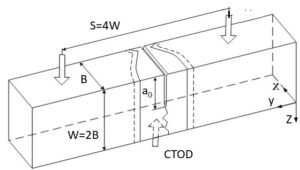
CTOD

Benefits for Pipeline Projects (CSA Z662)

  • Qualifies pipeline weld & HAZ toughness for construction approval and fitness-for-service.
  • Supports WPS/PQR development and verification under pipeline service conditions.
  • Enables ECA-based acceptance of weld imperfections to minimize unnecessary repairs.
  • Reduces risk of brittle fracture in cold service; provides inputs for structural integrity/FEA.

Industries We Serve

  • Pipeline construction and transmission, oil & gas gathering and transmission systems.
  • Offshore/subsea pipeline projects, pressure-piping and process facilities.
  • Engineering design & failure-analysis organizations.

Other Qualitest Services

  • Charpy Impact & Fracture Toughness (K_IC/J)
  • WPS/PQR & Welder Certification (CSA W47.1/W59/Z662)
  • Metallography & Hardness Mapping
  • Chemical Analysis (OES, ICP-OES)
  • NDT (UT, MT, PT, RT, AE, GPR)
  • Concrete, Asphalt & Aggregate Testing
  • Geotechnical & Environmental Investigations

Contact Us

📧 Email: admin@qualitests.com

  • Ontario Office: 5, 760 Laurentian Dr, Burlington, ON L7N 3V6 | ☎ (647) 464-9480
  • Alberta Office (Nisku): 702 – 23 Ave, Nisku, AB T9E 7Y6 | ☎ (780) 851-2020
  • Alberta Office (Calgary): Calgary, AB T2G-3K6 | ☎ (587) 747-3787
  • British Columbia Office: 112, 13085 115 Ave, Surrey, BC V3R 0C3 | ☎ (778) 381-7376
qualitest2016 No Comments

CTOD Testing as per CSA Z662 in Vancouver Canada

CTOD Testing as per CSA Z662 in Vancouver Canada

Qualitest Canada provides specialized CTOD Testing as per CSA Z662 in Vancouver Canada for pipeline steels and girth-welds. Our ISO/IEC 17025–accredited labs and fracture-mechanics engineers deliver precise CTOD data to support pipeline weld qualification, engineering critical assessments (ECA), and fitness-for-service.

We proudly serve clients across Canada, including Toronto, Halifax, Nisku, Calgary, Red Deer, Grande Prairie, Fort McMurray, Regina, Saskatoon, Vancouver, Surrey, Burnaby, Kamloops, Kelowna, Mississauga, Hamilton, Sarnia, Ottawa, London, Windsor, and Sudbury.

Understanding CTOD for Pipelines (CSA Z662)

CTOD measures the opening displacement at a crack tip immediately prior to fracture and is used in CSA Z662 to characterize fracture toughness of pipeline steels and weldments, especially at low temperatures and under pipeline service loading. For pipeline girth-weld assessments, CTOD testing follows ASTM E1820 or ISO 15653, with specimens taken from the 12 o’clock position and oriented parallel to the pipe axis. Shallow-crack geometry is permitted with the E1820 equations applied to surface CMOD measurements.

Pre-cracking and temperature: Typical programs test at the minimum design temperature; pre-cracking must meet E1820 criteria (e.g., extend by ≥ 1.3 mm or ao/2, whichever is less) with crack-front straightness controls. CSA Z662 uses the minimum of twelve CTOD values for subsequent acceptance calculations.

ECA in CSA Z662 (Annex J / Annex K)

When weld indications exceed standard workmanship limits, CSA Z662 Annex J allows an Engineering Critical Assessment (ECA) to determine tolerable flaw sizes based on measured toughness (CTOD) and real service stresses. Annex K provides fracture-mechanics-based acceptance options (e.g., classic CTOD design curve or Failure Assessment Diagram) that companies may adopt for construction or specific cases.

Why Qualitest Canada

  • ISO/IEC 17025–accredited fracture-mechanics facilities with sub-zero temperature control (–100 °C to +25 °C).
  • Servo-hydraulic CTOD frames with high-resolution clip-on COD/CMOD gauges.
  • CSA Z662 / BS 7448 / ASTM E1820 expertise for pipelines, girth-welds, HAZ, and line-pipe steels.
  • Comprehensive reporting: load–CMOD plots, δ (CTOD) values, fracture photos, and code-specific compliance notes.

(E1820/15653 applicability to shallow cracks and pipeline orientations per CSA Z662 commentary.)

Our CTOD Testing Capabilities

  • Specimens: SENB B×2B (preferred) or B×B; specimens from 12 o’clock, oriented parallel to pipe axis.
  • Pre-crack: Per E1820; extend ≥ 1.3 mm or ao/2; control crack-front straightness.
  • Environment: Ambient to sub-zero per project spec (e.g., minimum design temperature).
  • Acquisition: Load + CMOD synchronized; surface CMOD for shallow-crack analysis.
  • Data reduction: δ₅ / δc and J-integral as required; minimum of 12 CTOD values used for acceptance calculations.

CTOD

Benefits for Pipeline Projects (CSA Z662)

  • Qualifies pipeline weld & HAZ toughness for construction approval and fitness-for-service.
  • Supports WPS/PQR development and verification under pipeline service conditions.
  • Enables ECA-based acceptance of weld imperfections to minimize unnecessary repairs.
  • Reduces risk of brittle fracture in cold service; provides inputs for structural integrity/FEA.

Industries We Serve

  • Pipeline construction and transmission, oil & gas gathering and transmission systems.
  • Offshore/subsea pipeline projects, pressure-piping and process facilities.
  • Engineering design & failure-analysis organizations.

Other Qualitest Services

  • Charpy Impact & Fracture Toughness (K_IC/J)
  • WPS/PQR & Welder Certification (CSA W47.1/W59/Z662)
  • Metallography & Hardness Mapping
  • Chemical Analysis (OES, ICP-OES)
  • NDT (UT, MT, PT, RT, AE, GPR)
  • Concrete, Asphalt & Aggregate Testing
  • Geotechnical & Environmental Investigations

Contact Us

📧 Email: admin@qualitests.com

  • Ontario Office: 5, 760 Laurentian Dr, Burlington, ON L7N 3V6 | ☎ (647) 464-9480
  • Alberta Office (Nisku): 702 – 23 Ave, Nisku, AB T9E 7Y6 | ☎ (780) 851-2020
  • Alberta Office (Calgary): Calgary, AB T2G-3K6 | ☎ (587) 747-3787
  • British Columbia Office: 112, 13085 115 Ave, Surrey, BC V3R 0C3 | ☎ (778) 381-7376
qualitest2016 No Comments

CTOD Testing as per CSA Z662 in Edmonton Canada 

CTOD Testing as per CSA Z662 in Edmonton Canada

Qualitest Canada provides specialized CTOD Testing as per CSA Z662 in Edmonton Canada for pipeline steels and girth-welds. Our ISO/IEC 17025–accredited labs and fracture-mechanics engineers deliver precise CTOD data to support pipeline weld qualification, engineering critical assessments (ECA), and fitness-for-service.

We proudly serve clients across Canada, including Toronto, Halifax, Nisku, Calgary, Red Deer, Grande Prairie, Fort McMurray, Regina, Saskatoon, Vancouver, Surrey, Burnaby, Kamloops, Kelowna, Mississauga, Hamilton, Sarnia, Ottawa, London, Windsor, and Sudbury.

Understanding CTOD for Pipelines (CSA Z662)

CTOD measures the opening displacement at a crack tip immediately prior to fracture and is used in CSA Z662 to characterize fracture toughness of pipeline steels and weldments, especially at low temperatures and under pipeline service loading. For pipeline girth-weld assessments, CTOD testing follows ASTM E1820 or ISO 15653, with specimens taken from the 12 o’clock position and oriented parallel to the pipe axis. Shallow-crack geometry is permitted with the E1820 equations applied to surface CMOD measurements.

Pre-cracking and temperature: Typical programs test at the minimum design temperature; pre-cracking must meet E1820 criteria (e.g., extend by ≥ 1.3 mm or ao/2, whichever is less) with crack-front straightness controls. CSA Z662 uses the minimum of twelve CTOD values for subsequent acceptance calculations.

ECA in CSA Z662 (Annex J / Annex K)

When weld indications exceed standard workmanship limits, CSA Z662 Annex J allows an Engineering Critical Assessment (ECA) to determine tolerable flaw sizes based on measured toughness (CTOD) and real service stresses. Annex K provides fracture-mechanics-based acceptance options (e.g., classic CTOD design curve or Failure Assessment Diagram) that companies may adopt for construction or specific cases.

Why Qualitest Canada

  • ISO/IEC 17025–accredited fracture-mechanics facilities with sub-zero temperature control (–100 °C to +25 °C).
  • Servo-hydraulic CTOD frames with high-resolution clip-on COD/CMOD gauges.
  • CSA Z662 / BS 7448 / ASTM E1820 expertise for pipelines, girth-welds, HAZ, and line-pipe steels.
  • Comprehensive reporting: load–CMOD plots, δ (CTOD) values, fracture photos, and code-specific compliance notes.

(E1820/15653 applicability to shallow cracks and pipeline orientations per CSA Z662 commentary.)

Our CTOD Testing Capabilities

  • Specimens: SENB B×2B (preferred) or B×B; specimens from 12 o’clock, oriented parallel to pipe axis.
  • Pre-crack: Per E1820; extend ≥ 1.3 mm or ao/2; control crack-front straightness.
  • Environment: Ambient to sub-zero per project spec (e.g., minimum design temperature).
  • Acquisition: Load + CMOD synchronized; surface CMOD for shallow-crack analysis.
  • Data reduction: δ₅ / δc and J-integral as required; minimum of 12 CTOD values used for acceptance calculations.

CTOD

Benefits for Pipeline Projects (CSA Z662)

  • Qualifies pipeline weld & HAZ toughness for construction approval and fitness-for-service.
  • Supports WPS/PQR development and verification under pipeline service conditions.
  • Enables ECA-based acceptance of weld imperfections to minimize unnecessary repairs.
  • Reduces risk of brittle fracture in cold service; provides inputs for structural integrity/FEA.

Industries We Serve

  • Pipeline construction and transmission, oil & gas gathering and transmission systems.
  • Offshore/subsea pipeline projects, pressure-piping and process facilities.
  • Engineering design & failure-analysis organizations.

Other Qualitest Services

  • Charpy Impact & Fracture Toughness (K_IC/J)
  • WPS/PQR & Welder Certification (CSA W47.1/W59/Z662)
  • Metallography & Hardness Mapping
  • Chemical Analysis (OES, ICP-OES)
  • NDT (UT, MT, PT, RT, AE, GPR)
  • Concrete, Asphalt & Aggregate Testing
  • Geotechnical & Environmental Investigations

Contact Us

📧 Email: admin@qualitests.com

  • Ontario Office: 5, 760 Laurentian Dr, Burlington, ON L7N 3V6 | ☎ (647) 464-9480
  • Alberta Office (Nisku): 702 – 23 Ave, Nisku, AB T9E 7Y6 | ☎ (780) 851-2020
  • Alberta Office (Calgary): Calgary, AB T2G-3K6 | ☎ (587) 747-3787
  • British Columbia Office: 112, 13085 115 Ave, Surrey, BC V3R 0C3 | ☎ (778) 381-7376
qualitest2016 No Comments

CTOD Testing as per API 1104 in Edmonton Canada 

CTOD Testing as per API 1104 in Edmonton Canada 

Qualitest Canada provides specialized CTOD Testing as per API Standard 1104 in Edmonton Canada ensuring full compliance with API 1104: Welding of Pipelines and Related Facilities, including Annex A.3.4.3 Fracture-Toughness Testing. Our ISO/IEC 17025-accredited laboratories and experienced fracture-mechanics engineers deliver precise and reliable CTOD results for pipeline weld qualification, engineering critical assessments (ECA), and fitness-for-service evaluations across Canada.

Our ISO/IEC 17025–accredited laboratories and experienced fracture-mechanics engineers deliver precise CTOD data supporting pipeline weld procedure qualification, engineering critical assessments (ECA), and fitness-for-service evaluations.

We proudly serve clients across Canada — including Toronto, Halifax, Nisku, Calgary, Red Deer, Grande Prairie, Fort McMurray, Regina, Saskatoon, Vancouver, Surrey, Burnaby, Kamloops, Kelowna, Mississauga, Hamilton, Sarnia, Ottawa, London, Windsor, and Sudbury — as well as international pipeline operators and EPC firms.

Understanding CTOD Testing per API 1104

  • CTOD testing measures the fracture-toughness and crack-propagation resistance of weld metal and heat-affected zones (HAZ) in pipeline steels.
  • Under API 1104 Annex A.3.4.3, each welding procedure requires CTOD tests on both the weld metal and the HAZ, using at least three valid specimens per location — typically at the 12 o’clock, 3 o’clock (or 9 o’clock), and 6 o’clock positions on the test weld.
  • Specimens are oriented parallel to the pipe axis (through-thickness crack direction) and tested at or below the minimum design temperature.
  • API 1104 specifies that BS EN ISO 15653 criteria be applied for geometry and crack-front straightness, with valid δ-values (δc, δu, or δm) reported per ISO definitions

CTOD Specimen Orientation and Preparation

  • Specimen geometry: Preferred B × 2B (single-edge notched bend SENB) configuration
  • Orientation: Length parallel to pipe axis, crack tip through thickness
  • Weld metal tests: Notch and fatigue crack tip located centrally in the weld
  • HAZ tests: Pre-cracks aimed at coarse-grain HAZ within the central 70 % of thickness
  • Minimum valid CTOD: 0.002 in (0.05 mm) for acceptance of procedure qualification

Applicable Codes and Standards

  • API Standard 1104 – Welding of Pipelines and Related Facilities (Annex A.3.4.3 Fracture-Toughness Testing)
  • BS EN ISO 15653 – Fracture-Toughness Testing of Welds (CTOD Method)
  • ASTM E1820 / E1290 – J-Integral and CTOD Measurement Methods
  • CSA Z662 Annex K – Correlative guidance for FAD/ECA assessment (using API 1104 formulation)

Why Choose Qualitest Canada

  • ISO/IEC 17025–accredited facilities with sub-zero testing capability (–100 °C to +25 °C)
  • Servo-hydraulic CTOD frames with high-resolution clip-on COD/CMOD gauges
  • Expertise in API 1104, BS EN ISO 15653, and ASTM E1820 fracture-mechanics methods
  • Comprehensive reporting including load–CMOD curves, fracture photographs, and δ value classification

Our CTOD Testing Capabilities

  • Specimens: B × 2B or B × B SENB; extracted from 12 o’clock position
  • Pre-crack: Fatigue extension ≥ 1.3 mm or ao/2; crack-front straightness per BS EN ISO 15653
  • Temperature: At or below minimum design temperature
  • Measurement: Synchronized load and CMOD acquisition
  • Reporting: δc, δu, or δm values with fracture surface records and photographs

Benefits of CTOD Testing per API 1104

  • Ensures fracture-toughness qualification of pipeline weld metal and HAZ
  • Supports WPS/PQR approvals and fitness-for-purpose evaluations
  • Provides data for ECA and FAD analysis of imperfections (A.5.1.2 – Options 1 & 2)
  • Minimizes repairs by allowing toughness-based acceptance criteria
  • Enhances reliability in low-temperature and high-stress pipeline service

CTOD

Industries We Serve

  • Pipeline Construction and Transmission
  • Oil & Gas and Energy Infrastructure
  • Offshore and Subsea Pipeline Projects
  • Pressure-Piping and Process Facilities
  • Engineering Design and Failure-Analysis Consultancies

Other Qualitest Services

  • Charpy Impact & Fracture Toughness Testing (K_IC / J)
  • WPS/PQR Qualification & Welder Certification (API 1104 / CSA Z662)
  • Metallography & Hardness Mapping
  • Chemical Analysis (OES, ICP-OES)
  • NDT (UT, MT, PT, RT, AE, GPR)
  • Concrete, Asphalt & Aggregate Testing
  • Geotechnical & Environmental Investigations

Contact Us

📧 Email: admin@qualitests.com

  • Ontario Office: 5, 760 Laurentian Dr, Burlington, ON L7N 3V6 | ☎ (647) 464-9480
  • Alberta Office (Nisku): 702 – 23 Ave, Nisku, AB T9E 7Y6 | ☎ (780) 851-2020
  • Alberta Office (Calgary): Calgary, AB T2G-3K6 | ☎ (587) 747-3787
  • British Columbia Office: 112, 13085 115 Ave, Surrey, BC V3R 0C3 | ☎ (778) 381-7376
qualitest2016 No Comments

CTOD Testing as per API 1104 – Pipeline Weld and Fracture-Toughness Qualification

CTOD Testing as per API 1104 – Pipeline Weld and Fracture-Toughness Qualification

Qualitest Canada provides specialized CTOD (Crack Tip Opening Displacement) Testing services in full compliance with API Standard 1104: Welding of Pipelines and Related Facilities, including Annex A.3.4.3 Fracture-Toughness Testing.

Our ISO/IEC 17025–accredited laboratories and experienced fracture-mechanics engineers deliver precise CTOD data supporting pipeline weld procedure qualification, engineering critical assessments (ECA), and fitness-for-service evaluations.

We proudly serve clients across Canada — including Toronto, Halifax, Nisku, Calgary, Red Deer, Grande Prairie, Fort McMurray, Regina, Saskatoon, Vancouver, Surrey, Burnaby, Kamloops, Kelowna, Mississauga, Hamilton, Sarnia, Ottawa, London, Windsor, and Sudbury — as well as international pipeline operators and EPC firms.

Understanding CTOD Testing per API 1104

  • CTOD testing measures the fracture-toughness and crack-propagation resistance of weld metal and heat-affected zones (HAZ) in pipeline steels.
  • Under API 1104 Annex A.3.4.3, each welding procedure requires CTOD tests on both the weld metal and the HAZ, using at least three valid specimens per location — typically at the 12 o’clock, 3 o’clock (or 9 o’clock), and 6 o’clock positions on the test weld.
  • Specimens are oriented parallel to the pipe axis (through-thickness crack direction) and tested at or below the minimum design temperature.
  • API 1104 specifies that BS EN ISO 15653 criteria be applied for geometry and crack-front straightness, with valid δ-values (δc, δu, or δm) reported per ISO definitions

CTOD Specimen Orientation and Preparation

  • Specimen geometry: Preferred B × 2B (single-edge notched bend SENB) configuration
  • Orientation: Length parallel to pipe axis, crack tip through thickness
  • Weld metal tests: Notch and fatigue crack tip located centrally in the weld
  • HAZ tests: Pre-cracks aimed at coarse-grain HAZ within the central 70 % of thickness
  • Minimum valid CTOD: 0.002 in (0.05 mm) for acceptance of procedure qualification

Applicable Codes and Standards

  • API Standard 1104 – Welding of Pipelines and Related Facilities (Annex A.3.4.3 Fracture-Toughness Testing)
  • BS EN ISO 15653 – Fracture-Toughness Testing of Welds (CTOD Method)
  • ASTM E1820 / E1290 – J-Integral and CTOD Measurement Methods
  • CSA Z662 Annex K – Correlative guidance for FAD/ECA assessment (using API 1104 formulation)

Why Choose Qualitest Canada

  • ISO/IEC 17025–accredited facilities with sub-zero testing capability (–100 °C to +25 °C)
  • Servo-hydraulic CTOD frames with high-resolution clip-on COD/CMOD gauges
  • Expertise in API 1104, BS EN ISO 15653, and ASTM E1820 fracture-mechanics methods
  • Comprehensive reporting including load–CMOD curves, fracture photographs, and δ value classification

Our CTOD Testing Capabilities

  • Specimens: B × 2B or B × B SENB; extracted from 12 o’clock position
  • Pre-crack: Fatigue extension ≥ 1.3 mm or ao/2; crack-front straightness per BS EN ISO 15653
  • Temperature: At or below minimum design temperature
  • Measurement: Synchronized load and CMOD acquisition
  • Reporting: δc, δu, or δm values with fracture surface records and photographs

Benefits of CTOD Testing per API 1104

  • Ensures fracture-toughness qualification of pipeline weld metal and HAZ
  • Supports WPS/PQR approvals and fitness-for-purpose evaluations
  • Provides data for ECA and FAD analysis of imperfections (A.5.1.2 – Options 1 & 2)
  • Minimizes repairs by allowing toughness-based acceptance criteria
  • Enhances reliability in low-temperature and high-stress pipeline service

CTOD

Industries We Serve

  • Pipeline Construction and Transmission
  • Oil & Gas and Energy Infrastructure
  • Offshore and Subsea Pipeline Projects
  • Pressure-Piping and Process Facilities
  • Engineering Design and Failure-Analysis Consultancies

Other Qualitest Services

  • Charpy Impact & Fracture Toughness Testing (K_IC / J)
  • WPS/PQR Qualification & Welder Certification (API 1104 / CSA Z662)
  • Metallography & Hardness Mapping
  • Chemical Analysis (OES, ICP-OES)
  • NDT (UT, MT, PT, RT, AE, GPR)
  • Concrete, Asphalt & Aggregate Testing
  • Geotechnical & Environmental Investigations

Contact Us

📧 Email: admin@qualitests.com

  • Ontario Office: 5, 760 Laurentian Dr, Burlington, ON L7N 3V6 | ☎ (647) 464-9480
  • Alberta Office (Nisku): 702 – 23 Ave, Nisku, AB T9E 7Y6 | ☎ (780) 851-2020
  • Alberta Office (Calgary): Calgary, AB T2G-3K6 | ☎ (587) 747-3787
  • British Columbia Office: 112, 13085 115 Ave, Surrey, BC V3R 0C3 | ☎ (778) 381-7376
qualitest2016 No Comments

CTOD Testing per CSA Z662 – Pipeline Weld & Material Qualification

CTOD Testing per CSA Z662 – Pipeline Weld & Material Qualification (Canada)

Qualitest Canada provides specialized CTOD (Crack Tip Opening Displacement) Testing for pipeline steels and girth-welds in accordance with CSA Z662 and referenced methods (ASTM E1820 / ISO 15653). Our ISO/IEC 17025–accredited labs and fracture-mechanics engineers deliver precise CTOD data to support pipeline weld qualification, engineering critical assessments (ECA), and fitness-for-service.

We proudly serve clients across Canada, including Toronto, Halifax, Nisku, Calgary, Red Deer, Grande Prairie, Fort McMurray, Regina, Saskatoon, Vancouver, Surrey, Burnaby, Kamloops, Kelowna, Mississauga, Hamilton, Sarnia, Ottawa, London, Windsor, and Sudbury.

Understanding CTOD for Pipelines (CSA Z662)

CTOD measures the opening displacement at a crack tip immediately prior to fracture and is used in CSA Z662 to characterize fracture toughness of pipeline steels and weldments, especially at low temperatures and under pipeline service loading. For pipeline girth-weld assessments, CTOD testing follows ASTM E1820 or ISO 15653, with specimens taken from the 12 o’clock position and oriented parallel to the pipe axis. Shallow-crack geometry is permitted with the E1820 equations applied to surface CMOD measurements.

Pre-cracking and temperature: Typical programs test at the minimum design temperature; pre-cracking must meet E1820 criteria (e.g., extend by ≥ 1.3 mm or ao/2, whichever is less) with crack-front straightness controls. CSA Z662 uses the minimum of twelve CTOD values for subsequent acceptance calculations.

ECA in CSA Z662 (Annex J / Annex K)

When weld indications exceed standard workmanship limits, CSA Z662 Annex J allows an Engineering Critical Assessment (ECA) to determine tolerable flaw sizes based on measured toughness (CTOD) and real service stresses. Annex K provides fracture-mechanics-based acceptance options (e.g., classic CTOD design curve or Failure Assessment Diagram) that companies may adopt for construction or specific cases.

Why Qualitest Canada

  • ISO/IEC 17025–accredited fracture-mechanics facilities with sub-zero temperature control (–100 °C to +25 °C).
  • Servo-hydraulic CTOD frames with high-resolution clip-on COD/CMOD gauges.
  • CSA Z662 / BS 7448 / ASTM E1820 expertise for pipelines, girth-welds, HAZ, and line-pipe steels.
  • Comprehensive reporting: load–CMOD plots, δ (CTOD) values, fracture photos, and code-specific compliance notes.

(E1820/15653 applicability to shallow cracks and pipeline orientations per CSA Z662 commentary.)

Our CTOD Testing Capabilities

  • Specimens: SENB B×2B (preferred) or B×B; specimens from 12 o’clock, oriented parallel to pipe axis.
  • Pre-crack: Per E1820; extend ≥ 1.3 mm or ao/2; control crack-front straightness.
  • Environment: Ambient to sub-zero per project spec (e.g., minimum design temperature).
  • Acquisition: Load + CMOD synchronized; surface CMOD for shallow-crack analysis.
  • Data reduction: δ₅ / δc and J-integral as required; minimum of 12 CTOD values used for acceptance calculations.

CTOD

Benefits for Pipeline Projects (CSA Z662)

  • Qualifies pipeline weld & HAZ toughness for construction approval and fitness-for-service.
  • Supports WPS/PQR development and verification under pipeline service conditions.
  • Enables ECA-based acceptance of weld imperfections to minimize unnecessary repairs.
  • Reduces risk of brittle fracture in cold service; provides inputs for structural integrity/FEA.

Industries We Serve

  • Pipeline construction and transmission, oil & gas gathering and transmission systems.
  • Offshore/subsea pipeline projects, pressure-piping and process facilities.
  • Engineering design & failure-analysis organizations.

Other Qualitest Services

  • Charpy Impact & Fracture Toughness (K_IC/J)
  • WPS/PQR & Welder Certification (CSA W47.1/W59/Z662)
  • Metallography & Hardness Mapping
  • Chemical Analysis (OES, ICP-OES)
  • NDT (UT, MT, PT, RT, AE, GPR)
  • Concrete, Asphalt & Aggregate Testing
  • Geotechnical & Environmental Investigations

Contact Us

📧 Email: admin@qualitests.com

  • Ontario Office: 5, 760 Laurentian Dr, Burlington, ON L7N 3V6 | ☎ (647) 464-9480
  • Alberta Office (Nisku): 702 – 23 Ave, Nisku, AB T9E 7Y6 | ☎ (780) 851-2020
  • Alberta Office (Calgary): Calgary, AB T2G-3K6 | ☎ (587) 747-3787
  • British Columbia Office: 112, 13085 115 Ave, Surrey, BC V3R 0C3 | ☎ (778) 381-7376
qualitest2016 No Comments

CTOD Testing as per CSA W59 Annex U to meet welding qualification requirements for fixed steel offshore structures

CTOD Testing as per CSA W59 Annex U to meet welding qualification requirements for fixed steel offshore structures

Qualitest Canada offers specialized CTOD Testing as per CSA W59 Annex U, serving clients across Canada in the offshore, marine, and structural fabrication industries. Our Crack Tip Opening Displacement (CTOD) Testing services are performed in full compliance with CSA W59 Annex U standards, ensuring accurate fracture-toughness evaluation of welds and materials used in offshore structures, pipelines, and heavy steel fabrications.

With advanced fracture-mechanics testing equipment and a team of highly qualified metallurgical and welding engineers, our ISO/IEC 17025-accredited laboratories deliver precise and reliable CTOD results that support compliance with CSA W59, BS 7448, ASTM E1820, and ISO 12135.

We proudly serve clients throughout Canada, including Halifax, Nisku, Calgary, Red Deer, Grande Prairie, Fort McMurray, Regina, Saskatoon, Vancouver, Surrey, Burnaby, Kamloops, Kelowna, Mississauga, Hamilton, Sarnia, Ottawa, London, Windsor, and Sudbury.

Understanding CTOD Testing per CSA W59 Annex U

CTOD (Crack Tip Opening Displacement) testing is the fracture-toughness assessment method referenced in CSA W59 Annex U, which specifies additional requirements for weld metal and heat-affected zone (HAZ) toughness in offshore and low-temperature structural applications.

The test determines the resistance of a material or weld to crack propagation under loading by measuring the displacement at the crack tip immediately before failure. This data defines the fracture-toughness parameter δ (delta), which is critical in evaluating brittle-fracture resistance.

In offshore or arctic environments—where temperatures can drop below –40 °C—CSA W59 Annex U mandates that Crack Tip Opening Displacement testing be performed on representative weld joints to ensure structural integrity and safety.

Applicable Standards and Codes

  • CSA W59 Annex U – Supplementary Requirements for Offshore Structures
    Defines CTOD test conditions, sampling, and acceptance criteria for weld metal and HAZ toughness.
  • BS 7448 Part 1 & 2 – Fracture-toughness testing (CTOD Method)
  • ASTM E1820 / E1290 – J-integral and CTOD measurement methods
  • ISO 12135 – Unified method for fracture-toughness determination

Why Choose Qualitest Canada

Qualitest Canada is one of Canada’s most trusted mechanical-testing and materials-engineering laboratories, with decades of experience supporting offshore, pipeline, and heavy-fabrication projects.

Our Halifax service network offers:

  • Accredited fracture-mechanics laboratories with low-temperature control capability
  • CTOD test frames (servo-hydraulic systems) with high-resolution clip-on COD gauges
  • Experienced CSA W59/Annex U and BS 7448-qualified engineers
  • Full subzero testing from –100 °C to +25 °C using environmental chambers
  • Comprehensive reporting with load–CMOD curves, fracture photographs, and δ-value calculations

Our CTOD Testing Capabilities

  • Specimen Configuration:
  • B×2B or B×B SENB (single-edge notched bend) specimens per Annex U geometry requirements
  • Pre-cracking:
  • Fatigue pre-crack to ASTM E1820 tolerances (a/W ≈ 0.45–0.55)
  • Test Environment:
  • Controlled temperature (ambient or subzero) per project specification
  • Measurement:
  • Simultaneous load and crack-mouth opening displacement (CMOD) monitoring
  • Data Reduction:
  • Determination of δ₅, δc, J-integral, and fracture classification per Annex U
  • Reporting:
  • Load–CMOD plots, δ values, fracture-surface photos, and CSA W59 Annex U compliance statement

Benefits of CTOD Testing per CSA W59 Annex U

  • Qualifies weld metal and HAZ toughness for offshore and arctic design
  • Ensures compliance with CSA W59 Annex U and project-specific offshore codes
  • Demonstrates fitness-for-service and fracture resistance under extreme conditions
  • Supports WPS/PQR approval for critical welded joints
  • Reduces the risk of brittle fracture and structural failure in cold service
  • Provides validated data for finite element modeling (FEA) and design verification
CTOD

Crack Tip Opening Displacement

Industries We Serve

  • Offshore Oil & Gas Platforms and Subsea Structures
  • Marine and Shipbuilding Industries
  • Pipeline and Pressure-Vessel Fabrication
  • Structural and Heavy Engineering Projects
  • Power Generation and Energy Infrastructure
  • Engineering Design and Failure-Analysis Firms

Other Services by Qualitest Canada

  • In addition to CTOD Testing per CSA W59 Annex U in Canada, we also provide:
  • Charpy Impact and Fracture Toughness Testing
  • WPS/PQR Qualification & Welder Certification (CSA W47.1/W59)
  • Metallographic Examination & Hardness Mapping
  • Chemical Analysis (OES, ICP-OES)
  • Non-Destructive Testing (UT, MT, PT, RT, AE, GPR)
  • Concrete, Asphalt, and Aggregate Testing
  • Geotechnical & Environmental Investigations

Contact Us

📧 Email: admin@qualitests.com

  • Ontario Office: 5, 760 Laurentian Dr, Burlington, ON L7N 3V6 | ☎ (647) 464-9480
  • Alberta Office (Nisku): 702 – 23 Ave, Nisku, AB T9E 7Y6 | ☎ (780) 851-2020
  • Alberta Office (Calgary): Calgary, AB T2G-3K6 | ☎ (587) 747-3787
  • British Columbia Office: 112, 13085 115 Ave, Surrey, BC V3R 0C3 | ☎ (778) 381-7376


qualitest2016 No Comments

CTOD Testing as per CSA W59 Annex U – Offshore Structure Qualification

CTOD Testing as per CSA W59 Annex U – Offshore Structure Qualification

Qualitest Canada provides specialized CTOD Testing as per CSA W59 Annex U for clients across Canada. Our Crack Tip Opening Displacement (CTOD) Testing services cover various product categories, including offshore components, and structural weldments, specifically in accordance with CSA W59 Annex U requirements for offshore and structural weld qualification.

With advanced fracture-mechanics testing equipment and a team of highly qualified metallurgical and welding engineers, our ISO/IEC 17025-accredited laboratories deliver precise and reliable CTOD results that support compliance with CSA W59, BS 7448, ASTM E1820, and ISO 12135.

We proudly serve clients throughout Canada, including Halifax, Nisku, Calgary, Red Deer, Grande Prairie, Fort McMurray, Regina, Saskatoon, Vancouver, Surrey, Burnaby, Kamloops, Kelowna, Mississauga, Hamilton, Sarnia, Ottawa, London, Windsor, and Sudbury.

Understanding CTOD Testing per CSA W59 Annex U

CTOD (Crack Tip Opening Displacement) testing is the fracture-toughness assessment method referenced in CSA W59 Annex U, which specifies additional requirements for weld metal and heat-affected zone (HAZ) toughness in offshore and low-temperature structural applications.

The test determines the resistance of a material or weld to crack propagation under loading by measuring the displacement at the crack tip immediately before failure. This data defines the fracture-toughness parameter δ (delta), which is critical in evaluating brittle-fracture resistance.

In offshore or arctic environments—where temperatures can drop below –40 °C—CSA W59 Annex U mandates that Crack Tip Opening Displacement testing be performed on representative weld joints to ensure structural integrity and safety.

Applicable Standards and Codes

  • CSA W59 Annex U – Supplementary Requirements for Offshore Structures
    Defines CTOD test conditions, sampling, and acceptance criteria for weld metal and HAZ toughness.
  • BS 7448 Part 1 & 2 – Fracture-toughness testing (CTOD Method)
  • ASTM E1820 / E1290 – J-integral and CTOD measurement methods
  • ISO 12135 – Unified method for fracture-toughness determination

Why Choose Qualitest Canada

Qualitest Canada is one of Canada’s most trusted mechanical-testing and materials-engineering laboratories, with decades of experience supporting offshore, pipeline, and heavy-fabrication projects.

Our Halifax service network offers:

  • Accredited fracture-mechanics laboratories with low-temperature control capability
  • CTOD test frames (servo-hydraulic systems) with high-resolution clip-on COD gauges
  • Experienced CSA W59/Annex U and BS 7448-qualified engineers
  • Full subzero testing from –100 °C to +25 °C using environmental chambers
  • Comprehensive reporting with load–CMOD curves, fracture photographs, and δ-value calculations

Our CTOD Testing Capabilities

  • Specimen Configuration:
  • B×2B or B×B SENB (single-edge notched bend) specimens per Annex U geometry requirements
  • Pre-cracking:
  • Fatigue pre-crack to ASTM E1820 tolerances (a/W ≈ 0.45–0.55)
  • Test Environment:
  • Controlled temperature (ambient or subzero) per project specification
  • Measurement:
  • Simultaneous load and crack-mouth opening displacement (CMOD) monitoring
  • Data Reduction:
  • Determination of δ₅, δc, J-integral, and fracture classification per Annex U
  • Reporting:
  • Load–CMOD plots, δ values, fracture-surface photos, and CSA W59 Annex U compliance statement

Benefits of CTOD Testing per CSA W59 Annex U

  • Qualifies weld metal and HAZ toughness for offshore and arctic design
  • Ensures compliance with CSA W59 Annex U and project-specific offshore codes
  • Demonstrates fitness-for-service and fracture resistance under extreme conditions
  • Supports WPS/PQR approval for critical welded joints
  • Reduces the risk of brittle fracture and structural failure in cold service
  • Provides validated data for finite element modeling (FEA) and design verification
CTOD

Crack Tip Opening Displacement

Industries We Serve

  • Offshore Oil & Gas Platforms and Subsea Structures
  • Marine and Shipbuilding Industries
  • Pipeline and Pressure-Vessel Fabrication
  • Structural and Heavy Engineering Projects
  • Power Generation and Energy Infrastructure
  • Engineering Design and Failure-Analysis Firms

Other Services by Qualitest Canada

  • In addition to CTOD Testing per CSA W59 Annex U in Canada, we also provide:
  • Charpy Impact and Fracture Toughness Testing
  • WPS/PQR Qualification & Welder Certification (CSA W47.1/W59)
  • Metallographic Examination & Hardness Mapping
  • Chemical Analysis (OES, ICP-OES)
  • Non-Destructive Testing (UT, MT, PT, RT, AE, GPR)
  • Concrete, Asphalt, and Aggregate Testing
  • Geotechnical & Environmental Investigations

Contact Us

📧 Email: admin@qualitests.com

  • Ontario Office: 5, 760 Laurentian Dr, Burlington, ON L7N 3V6 | ☎ (647) 464-9480
  • Alberta Office (Nisku): 702 – 23 Ave, Nisku, AB T9E 7Y6 | ☎ (780) 851-2020
  • Alberta Office (Calgary): Calgary, AB T2G-3K6 | ☎ (587) 747-3787
  • British Columbia Office: 112, 13085 115 Ave, Surrey, BC V3R 0C3 | ☎ (778) 381-7376


qualitest2016 No Comments

CTOD Testing Services in Halifax Canada

CTOD Testing Services in Halifax Canada

Qualitest Canada provides specialized Crack Tip Opening Displacement, CTOD Testing Services in Halifax Canada, with advanced fracture-mechanics testing equipment and highly qualified metallurgical engineers. Our accredited laboratories serve clients in every major industrial hub including Nisku, Calgary, Red Deer, Grande Prairie, Fort McMurray, Regina, Saskatoon, Vancouver, Surrey, Burnaby, Kamloops, Kelowna, Mississauga, Hamilton, Sarnia, Ottawa, London, Windsor, and Sudbury.

Understanding CTOD Testing

Qualitest Canada performs CTOD Testing Services in Halifax Canada for various clients around the world. CTOD (Crack Tip Opening Displacement) is a fracture-toughness test method used to determine the resistance of metallic materials—particularly steels and welds—to crack propagation under stress. The test measures the amount of deformation (opening displacement) that occurs at the tip of a crack before fracture.

This parameter is critical for evaluating structural integrity in welded joints, pipeline steels, offshore platforms, pressure vessels, and other high-stress components operating in demanding environments.

Common standards include:

  • BS 7448 Part 1 & 2 – Fracture toughness (CTOD) testing
  • ASTM E1820 / E1290 – Measurement of fracture toughness (J-integral, CTOD)
  • ISO 12135 – Metallic materials – Unified method for fracture toughness

Why Choose Qualitest Canada?

Qualitest Canada is one of Canada’s most trusted names in materials testing and failure analysis, with ISO/IEC 17025-accredited laboratories and a proven record of precision testing for the oil & gas, pipeline, structural steel, and fabrication industries.

Our CTOD testing program offers:

  • Experienced metallurgical and welding engineers
  • Advanced servo-hydraulic test frames with clip-on COD gauges
  • Temperature-controlled environmental chambers (for subzero testing)
  • Full compliance with ASTM, ISO, and BS standards
  • Comprehensive reporting with fracture-surface photography and data plots

Our CTOD Testing Capabilities

  • Specimen Preparation – B×2B or B×B single-edge notched bend (SENB) specimens
  • Pre-cracking – Fatigue pre-cracking to ASTM E1820 requirements
  • Test Environment – Ambient or subzero temperature (–100 °C to +25 °C)
  • Measurement – Crack mouth opening displacement (CMOD) and load recording
  • Results & Analysis – Determination of δ₅, δc, J-integral, and fracture classification
  • Reporting – Graphs of load vs. CMOD, fracture photos, and compliance statements

Benefits of CTOD Testing

  • Ensures fracture toughness qualification of welded structures
  • Confirms fitness-for-service in critical design applications
  • Supports weld procedure qualification (WPQ) and WPS validation
  • Aids in material selection for offshore and cryogenic service
  • Reduces risk of brittle fracture in low-temperature operations
  • Provides valuable input data for FEA and structural assessment

CTOD

Industries We Serve

  • Oil & Gas and Pipeline Construction
  • Offshore & Marine Engineering
  • Structural & Heavy Fabrication
  • Power Generation & Pressure Vessel Manufacturing
  • Mining & Industrial Equipment
  • Engineering Design and Failure Analysis Firms

Other Services by Qualitest Canada

In addition to CTOD Testing Services in Edmonton, Alberta, Qualitest Canada also provides:

  • Tensile, Charpy, and Fracture Toughness Testing
  • Welding Procedure Qualification (WPS/PQR) & Welder Certification
  • Metallographic Examination & Hardness Mapping
  • Chemical Analysis (OES, ICP-OES)
  • Non-Destructive Testing (UT, MT, PT, RT, AE, GPR)
  • Concrete, Asphalt, and Aggregate Testing
  • Geotechnical & Environmental Investigations

Contact Us

📧 Email: admin@qualitests.com

  • Ontario Office: 5, 760 Laurentian Dr, Burlington, ON L7N 3V6 | ☎ (647) 464-9480
  • Alberta Office (Nisku): 702 – 23 Ave, Nisku, AB T9E 7Y6 | ☎ (780) 851-2020
  • Alberta Office (Calgary): Calgary, AB T2G-3K6 | ☎ (587) 747-3787
  • British Columbia Office: 112, 13085 115 Ave, Surrey, BC V3R 0C3 | ☎ (778) 381-7376
qualitest2016 No Comments

CTOD Testing Services in Hamilton Ontario

CTOD Testing Services in Hamilton Ontario

Qualitest Canada provides specialized Crack Tip Opening Displacement, CTOD Testing Services in Hamilton Ontario, with advanced fracture-mechanics testing equipment and highly qualified metallurgical engineers. Our accredited laboratories serve clients in every major industrial hub including Nisku, Calgary, Red Deer, Grande Prairie, Fort McMurray, Regina, Saskatoon, Vancouver, Surrey, Burnaby, Kamloops, Kelowna, Mississauga, Hamilton, Sarnia, Ottawa, London, Windsor, and Sudbury.

Understanding CTOD Testing

Qualitest Canada performs CTOD Testing Services in Hamilton Ontario Canada for various clients around the world. CTOD (Crack Tip Opening Displacement) is a fracture-toughness test method used to determine the resistance of metallic materials—particularly steels and welds—to crack propagation under stress. The test measures the amount of deformation (opening displacement) that occurs at the tip of a crack before fracture.

This parameter is critical for evaluating structural integrity in welded joints, pipeline steels, offshore platforms, pressure vessels, and other high-stress components operating in demanding environments.

Common standards include:

  • BS 7448 Part 1 & 2 – Fracture toughness (CTOD) testing
  • ASTM E1820 / E1290 – Measurement of fracture toughness (J-integral, CTOD)
  • ISO 12135 – Metallic materials – Unified method for fracture toughness

Why Choose Qualitest Canada?

Qualitest Canada is one of Canada’s most trusted names in materials testing and failure analysis, with ISO/IEC 17025-accredited laboratories and a proven record of precision testing for the oil & gas, pipeline, structural steel, and fabrication industries.

Our CTOD testing program offers:

  • Experienced metallurgical and welding engineers
  • Advanced servo-hydraulic test frames with clip-on COD gauges
  • Temperature-controlled environmental chambers (for subzero testing)
  • Full compliance with ASTM, ISO, and BS standards
  • Comprehensive reporting with fracture-surface photography and data plots

Our CTOD Testing Capabilities

  • Specimen Preparation – B×2B or B×B single-edge notched bend (SENB) specimens
  • Pre-cracking – Fatigue pre-cracking to ASTM E1820 requirements
  • Test Environment – Ambient or subzero temperature (–100 °C to +25 °C)
  • Measurement – Crack mouth opening displacement (CMOD) and load recording
  • Results & Analysis – Determination of δ₅, δc, J-integral, and fracture classification
  • Reporting – Graphs of load vs. CMOD, fracture photos, and compliance statements

Benefits of CTOD Testing

  • Ensures fracture toughness qualification of welded structures
  • Confirms fitness-for-service in critical design applications
  • Supports weld procedure qualification (WPQ) and WPS validation
  • Aids in material selection for offshore and cryogenic service
  • Reduces risk of brittle fracture in low-temperature operations
  • Provides valuable input data for FEA and structural assessment

CTOD

Industries We Serve

  • Oil & Gas and Pipeline Construction
  • Offshore & Marine Engineering
  • Structural & Heavy Fabrication
  • Power Generation & Pressure Vessel Manufacturing
  • Mining & Industrial Equipment
  • Engineering Design and Failure Analysis Firms

Other Services by Qualitest Canada

In addition to CTOD Testing Services in Edmonton, Alberta, Qualitest Canada also provides:

  • Tensile, Charpy, and Fracture Toughness Testing
  • Welding Procedure Qualification (WPS/PQR) & Welder Certification
  • Metallographic Examination & Hardness Mapping
  • Chemical Analysis (OES, ICP-OES)
  • Non-Destructive Testing (UT, MT, PT, RT, AE, GPR)
  • Concrete, Asphalt, and Aggregate Testing
  • Geotechnical & Environmental Investigations

Contact Us

📧 Email: admin@qualitests.com

  • Ontario Office: 5, 760 Laurentian Dr, Burlington, ON L7N 3V6 | ☎ (647) 464-9480
  • Alberta Office (Nisku): 702 – 23 Ave, Nisku, AB T9E 7Y6 | ☎ (780) 851-2020
  • Alberta Office (Calgary): Calgary, AB T2G-3K6 | ☎ (587) 747-3787
  • British Columbia Office: 112, 13085 115 Ave, Surrey, BC V3R 0C3 | ☎ (778) 381-7376